Guides · By LawnTide · Updated July 20, 2026 · 7 min read
How to Measure Your Lawn's Soil Temperature (and When You Don't Have To)
Stick a soil thermometer 2 inches into your lawn, mid-morning, and read it. That number tells you more about when to seed, feed, or spread pre-emergent than the date on the calendar ever will. Air temperature lies. A warm afternoon in March doesn't mean the ground is ready. Soil temperature is what the grass and the weed seeds actually respond to.
Here's how to get an accurate reading, why 2 inches matters, and the shortcut that lets most people skip the thermometer entirely.
Why does soil temperature matter more than air temperature?
Grass roots, weed seeds, and soil microbes all take their cues from the dirt, not the air. Soil warms and cools slower than air, so it's a far steadier signal. That's why turf programs at land-grant universities time nearly every spring and fall task to soil temperature.
A few thresholds do most of the work:
- 50-55°F: Crabgrass and other summer annual weeds start germinating. Get pre-emergent down before you hit 55.
- 55-65°F: The sweet spot for seeding cool-season grasses like fescue and Kentucky bluegrass in fall.
- 65°F and up: Warm-season grasses (Bermuda, zoysia, St. Augustine) break dormancy and green up.
- 70°F+: Cool-season grass growth slows and heat stress sets in.
Miss these by chasing the calendar and you'll seed into cold ground that rots your investment, or spread pre-emergent two weeks after the crabgrass already sprouted. In Atlanta the soil can hit 55°F in early March. In Minneapolis it might be late April. Same calendar week, completely different lawn.
How do you measure soil temperature with a thermometer?
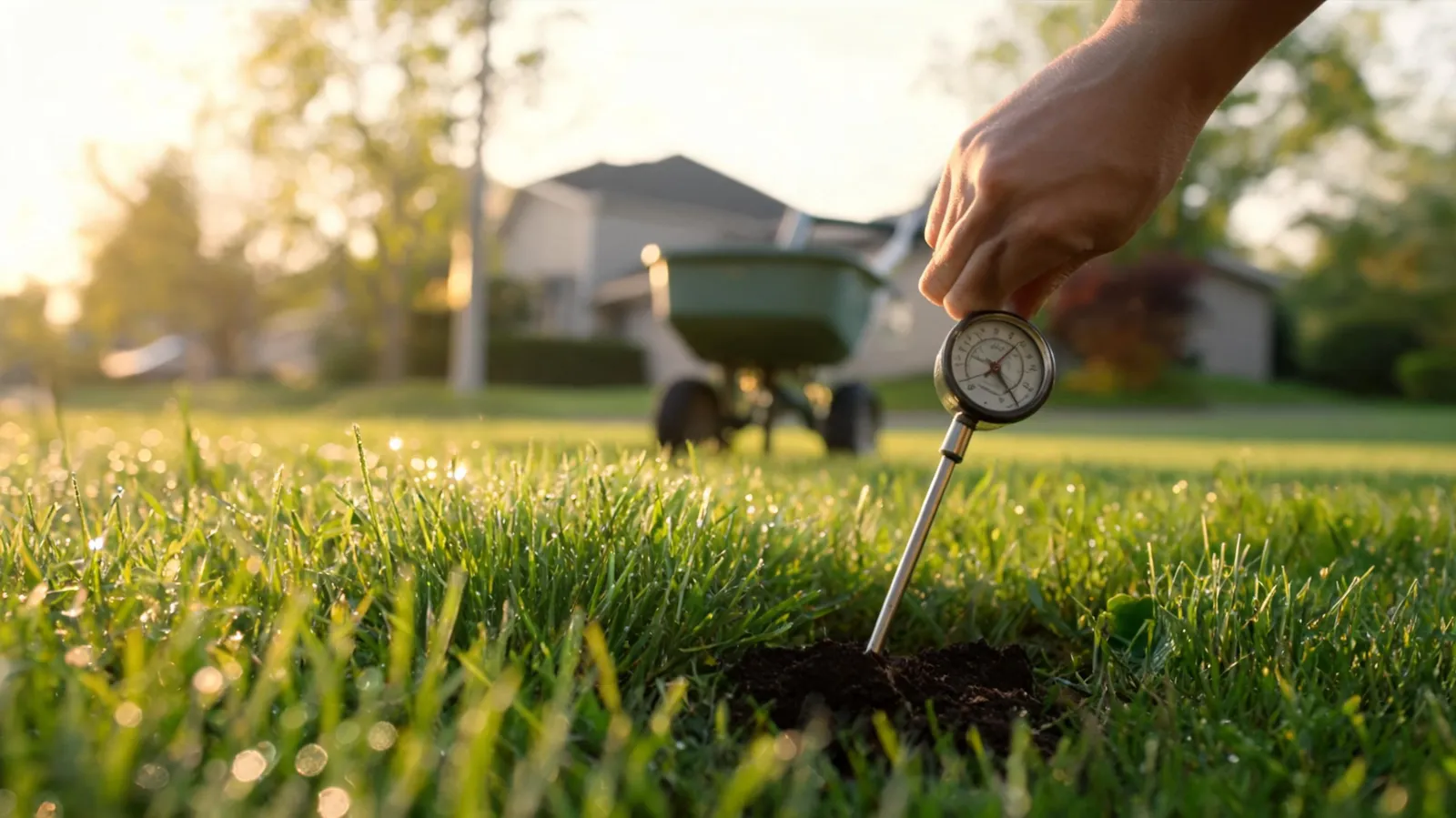
Push a soil thermometer 2 inches into the ground, wait for the needle to settle (about a minute), and read it mid-morning. Do it in three or four spots around the yard and average them. Repeat for three straight days before you act on the number.
Step by step:
- Get the right tool. A dial soil thermometer with a metal probe costs a few dollars at a garden center. A digital meat thermometer with a pointed metal stem works too. A regular glass air thermometer does not.
- Go 2 inches deep for most jobs. That's the zone where seeds sit and where crabgrass germinates. For established turf and warm-season green-up, some programs use 4 inches, but 2 inches is the standard reference you'll see quoted.
- Read it mid-morning, 9 to 11 a.m. This catches the daily average better than a hot afternoon or a cold dawn. Afternoon readings run several degrees high and will fool you into acting early.
- Sample several spots. A sunny south-facing strip warms faster than shade under a maple. Take three or four readings and average them so one hot patch doesn't skew your call.
- Track consecutive days. One warm reading means nothing. Wait until you've hit your target for three days in a row before you seed or spread.
Does the probe need to be metal? Yes. Plastic-tipped garden thermometers respond too slowly and read inaccurately at depth. A metal stem conducts fast and settles in about a minute.
What depth and time of day should you use?
Use 2 inches deep and 9-11 a.m. for seeding and pre-emergent timing. That depth matches where seeds and weed germination happen, and mid-morning captures a fair daily average. For tracking warm-season green-up, 4 inches is common. Always let the probe sit a full minute before reading.
Depth changes the number more than people expect. Surface soil swings wildly with the sun; go deeper and it steadies out. Here's the practical breakdown:
| Task | Depth | Best time | Target reading |
|---|---|---|---|
| Pre-emergent for crabgrass | 2 in | 9-11 a.m. | Apply before 55°F |
| Seeding cool-season grass (fall) | 2 in | 9-11 a.m. | 55-65°F |
| Seeding cool-season grass (spring) | 2 in | 9-11 a.m. | 55°F and rising |
| Warm-season green-up / feeding | 4 in | 9-11 a.m. | 65°F and rising |
| Dormant seeding done | soil frozen | any | below 40°F |
Time of day matters because soil temperature peaks in late afternoon and bottoms out before dawn. Mid-morning splits the difference. If you can only check at 4 p.m., knock a few degrees off in your head before deciding.
When does soil hit key thresholds in your region?
Soil crosses 55°F in spring anywhere from late February in the Deep South to mid-May in the northern tier and high elevations. Fall seeding windows run the reverse. Your ZIP and this year's weather decide the exact week, which is why a live reading beats any printed chart.
Rough spring timing for the 55°F pre-emergent and seeding threshold:
- Southeast (Atlanta, Charlotte, Raleigh): late February to mid-March.
- Southwest (Phoenix, Dallas, Albuquerque): February to late March, wide swings by elevation.
- Midwest (Columbus, Chicago, Kansas City): late March to late April.
- Northeast (Philadelphia, Boston, Pittsburgh): early to late April.
- Northwest (Portland, Seattle, Boise): late March to April, later inland and at altitude.
Note: Florida, coastal Southern California, and Hawaii rarely drop into dormancy, so their warm-season lawns run on a different clock. Watch for soil holding above 65°F rather than climbing to it. Note: High-elevation spots like Denver or Flagstaff lag their region by two to four weeks and can swing 20 degrees between a sunny day and a cold night.
If you're in Columbus and it's the last week of March, you're right at the edge of pre-emergent season. Check the soil before you assume you have time.
When don't you need a thermometer at all?
Most of the time. Weather stations and university networks already log soil temperature across the country, and that data is free. Unless you've got a big microclimate problem or you just like the ritual, you can skip the probe and pull a reading for your area in seconds.
Free ways to get soil temperature without buying anything:
- LawnTide's live ZIP lookup. Enter your ZIP at https://www.lawntide.com/lawn and get current soil temperature for your area, no thermometer required.
- State university extension networks. Many run mesonets with soil-temperature stations you can view online, though the nearest station may be miles away.
- NOAA and agricultural weather stations. Accurate but usually spaced far apart and aimed at farmers, not lawns.
The catch with any regional data source is distance. A station 15 miles away in a different microclimate can read a few degrees off from your backyard. That's fine for most decisions. If your lawn sits in deep shade, on a north slope, or in a frost pocket, a thermometer in your own dirt still wins.
Should I trust an app or measure it myself? For pre-emergent and seeding timing, regional data is close enough for the vast majority of lawns. Measure yourself only when your yard is an obvious outlier or when you want to confirm a reading before spending money on seed.
FAQ
What is the ideal soil temperature to plant grass seed?
Cool-season grasses like fescue and Kentucky bluegrass germinate best when soil sits between 55 and 65°F at 2 inches deep. Warm-season grasses like Bermuda need warmer soil, around 65 to 70°F. Fall is the stronger window for cool-season seeding because soil holds warm while air cools.
How deep should I measure soil temperature for crabgrass pre-emergent?
Measure at 2 inches deep, since that's where crabgrass seed germinates. Get your pre-emergent down before soil reaches a steady 55°F. Once you've held 55°F for a few days, germination is already underway and a pre-emergent barrier is late.
Can I use a meat thermometer to check soil temperature?
Yes, as long as it has a pointed metal probe. Push it 2 inches into the ground, wait about a minute for the reading to settle, and record it. A digital instant-read model works well. Just clean the probe before you cook with it again.
How many days should soil stay at a temperature before I act?
Wait for three consecutive days at your target before seeding or spreading pre-emergent. A single warm day, especially a sunny afternoon reading, can spike well above the real trend. Three days in a row confirms the soil has genuinely reached and held that temperature.
Stop guessing the timing — we'll watch your soil for you.
See your live soil temperature and this year's treatment windows for your ZIP, free.
Or get free email alerts — one plain-English email the week each task is due.
Every guide above comes down to your local soil temperature — see the live number and this year's windows for your city: